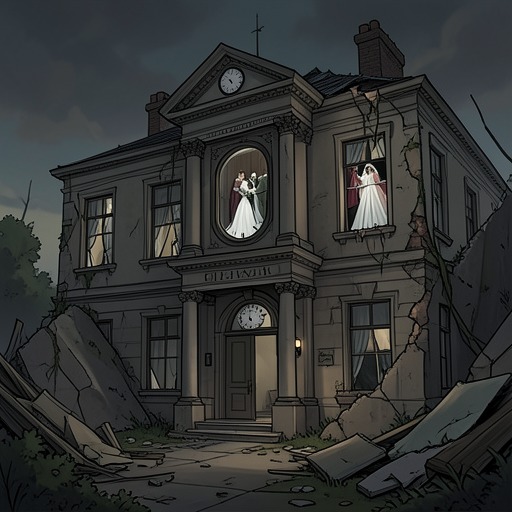
Miss Havisham’s wedding cake
Great ExpectationsMiss Havisham’s wedding cake is the decayed centerpiece of Satis House’s suspended wedding feast, a material sign of the past that Miss Havisham has kept from moving on. Seen beneath dust and cobwebs, and later beside her as she receives Pip, it connects the house’s physical ruin to the bridal identity and grief around which her life has been organized. Its final appearance in the fire scene joins that frozen tableau to an event that cannot be preserved or undone.
Appearance and Setting
The cake belongs to the long-table room, reached through the dark passages of Satis House. The first approach establishes the house’s closed, dim interior: the front entrance is secured by two chains, and Pip follows Estella through unlit passages and up a staircase by candlelight. In another room, a table remains laid as though a feast had been interrupted when the house and its clocks stopped. Dust and mould cover the furnishings; cobwebs obscure the central ornament, while insects and mice occupy the neglected space. The cake is part of this larger arrangement of bridal relics and disuse, not an isolated decoration.
The Cake as a Recurring Relic
When Pip returns to say goodbye before leaving for London, Miss Havisham is walking in the long-table room with her crutch stick. She stops beside the rotted bride-cake to address him. At the leave-taking, she stretches out her hand for him to kiss while standing beside the cake, hidden in cobwebs. The object thus remains in place across separate visits, marking the continuity of the room and of Miss Havisham’s preserved bridal setting.
During a later visit, Miss Havisham sends Pip and Estella to walk in the neglected garden, then asks Pip to wheel her about as in former times. The cake and the room’s other relics frame these returns to an earlier routine: the setting makes the past seem present even as the people who move through it have changed. That contrast is especially sharp for Pip, whose memories of Satis House are bound up with his childhood aspirations and his feelings for Estella.
Material Decay and Crisis
On a later sleepless night at Satis House, Pip finds the house’s old rooms and their bridal associations still pressing on his attention. The long-table room’s decay is part of the atmosphere of the night, when Miss Havisham moves through the passage and feast chamber carrying a candle. The repeated presence of the old setting makes the cake more than a single plot detail: it belongs to an environment in which time appears arrested, while deterioration continues.
The tableau is violently disrupted when Miss Havisham’s bridal dress catches fire beside the hearth. Pip sees her running toward him with flames around her, then uses his coats and a tablecloth to smother them. The account identifies the tablecloth and the surrounding heap of rottenness among the things pulled down in the struggle; afterward, the room is strewn with the remains of the bridal scene. The cake’s recurring presence therefore culminates not in a separate action of its own, but in the destruction and disturbance of the preserved wedding setting.
Narrative Significance
The cake makes Satis House’s arrested time visible through an object that has been left in the place of a feast long after its occasion has passed. Its rotting condition counters the formality of a wedding table: what was arranged for celebration has become evidence of neglect. By placing it beside Miss Havisham during Pip’s visits and leave-taking, the narrative links the physical relic to her continuing attachment to the abandoned bridal past.
Its recurrence also structures Pip’s perception of the house. The same room can serve as a site of childhood encounter, farewell, and later danger, while its objects seem to hold each moment within the old scene. When fire breaks into that setting, the bridal relics cease to function as a still-life of suspended grief and become part of a real emergency. The cake consequently signifies both the persistence of Miss Havisham’s past and the material decay that makes its attempted preservation impossible.